
Sometimes, the most powerful environmental messages do not come from world leaders, scientists or international organisations. Sometimes, they come from a child with a simple idea, a piece of paper and the courage to write a letter.
For 10-year-old Kenyan environmentalist Karen Kimani, that idea was simple: she wanted to plant a tree with King Charles III.
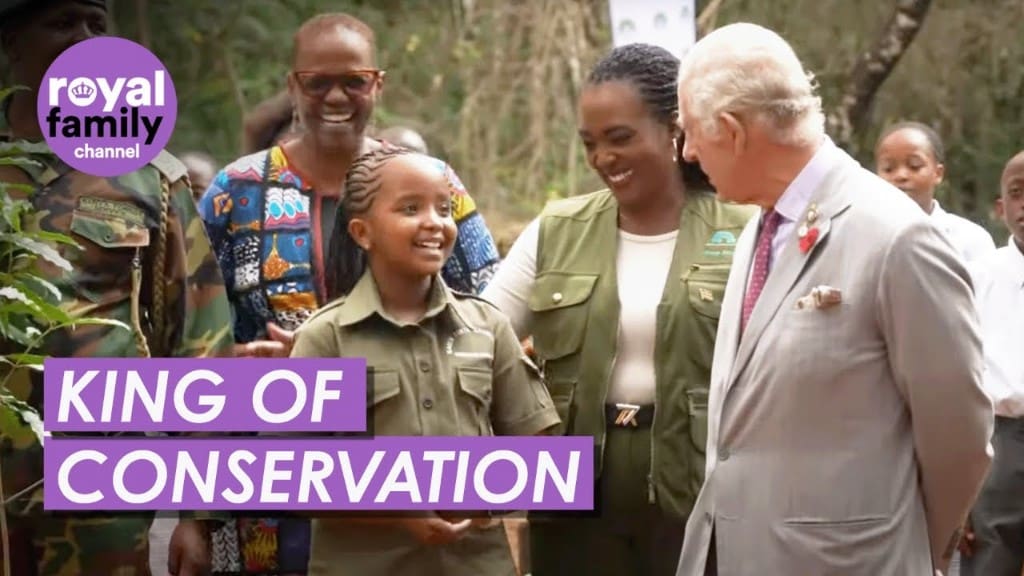
What began as a young girl's letter to Buckingham Palace became reality on November 1, 2023, when Karen stood alongside the British monarch in Nairobi's Karura Forest and planted an Elgon Teak tree together.
The moment formed one of the most memorable environmental encounters of King Charles III's first State Visit to Kenya as monarch.
A letter with a big request
Earlier in 2023, Karen wrote to Buckingham Palace with an unusual request. She asked the King if he would plant a tree with her when he visited Kenya.
It was the kind of request that could easily have remained unanswered amid the thousands of letters received by a royal household.
But Karen's message reached its destination.
During the King's visit to Kenya, she received the news that her wish had been accepted.
According to Karen, her mother received an email informing them that the King would indeed plant a tree with her. The young environmentalist later admitted that she had not expected her request to become reality.
“I decided to write a letter to the King because I wanted to let him know that children need their voices to be heard,” Karen explained after the meeting.
Her message was not simply about meeting royalty. It was about the environment — and about reminding adults that children have a stake in the future of the planet.
A meeting beneath the trees of Karura
On November 1, Karen's extraordinary request became reality.
King Charles III arrived at Karura Forest during the second day of his State Visit to Kenya. The visit focused on the importance of urban forests, conservation and the role of green spaces in creating sustainable cities.
The King was accompanied during part of his visit by Wanjira Mathai, daughter of the late Nobel Peace Prize laureate and environmental icon Wangari Maathai, whose historic campaign helped save Karura Forest from destruction.
It was in this historically significant forest that Charles met Karen.
Together, the King and the 10-year-old environmental campaigner planted an Elgon Teak — adding another tree to Karen's already remarkable conservation efforts.
The Royal Family later noted that the tree was the latest addition to the more than 10,000 trees Karen had already planted.
From a young conservationist to a royal environmental partner
Karen was not simply selected because she had written a letter to the King. She had already established herself as a passionate young environmental campaigner.
By the time she met Charles, she had planted more than 10,000 trees and championed environmental responsibility through her 3Rs initiative — Reduce, Reuse and Recycle.
Her environmental advocacy had also taken her onto an international stage. In 2019, she represented Kenya at the Little Miss and Mr United World event in Tenerife, Spain, where she received a Silver Award after presenting a plastic-bottle-themed outfit and a message promoting the three Rs.
Her meeting with the King therefore represented more than a ceremonial tree planting. It was an acknowledgement of the role that young people can play in environmental conservation.
“This was my wish”
After planting the tree, Karen described the experience with the excitement one would expect from a 10-year-old whose seemingly impossible dream had just come true.
She said she was excited and happy, explaining that planting a tree with the King had been her wish and that she had not expected him to actually come.
For Karen, the most important part was not the royal attention.
It was the message behind the request.
She wanted the King — and the wider world — to understand that children should have a voice in conversations about the environment and the future they will inherit.
A meeting that carried a bigger message
The symbolism of the moment was particularly powerful.
King Charles has spent decades advocating for environmental protection and sustainability. During his Kenya visit, he spoke at the United Nations Office in Nairobi about the threats posed by climate change, biodiversity loss and environmental destruction.
He called for society to respond through “action, partnership and commitment.”
At Karura Forest, that message was embodied in a simple act: an adult world leader and a young Kenyan environmentalist putting their hands into the soil together.
One represented generations of global leadership.
The other represented the generation that will inherit the consequences of today's environmental decisions.
And between them was a tree.
The letter that became a legacy
Karen's story is a reminder that meaningful change can begin with something remarkably small.
A child wrote a letter.
She made a request.
Someone listened.
And eventually, she stood in Karura Forest beside a King, planting a tree that would outlive the moment in which it was planted.
The significance of Karen's story lies not only in the fact that she met King Charles III. It lies in what made the meeting happen in the first place: a child believed her voice mattered enough to be heard.
The King honoured that voice.
And together, they planted something that Kenya and the world desperately need more of — hope, action and trees.
The Elgon Teak planted that day became more than another tree in Karura Forest. It became a living symbol of what can happen when young people are encouraged to speak, when leaders listen, and when environmental responsibility becomes something shared across generations.
Karen's letter travelled from Kenya to Buckingham Palace.
Its answer brought the King back to Kenya.
And on November 1, 2023, beneath the canopy of Karura Forest, a 10-year-old girl's simple request became a moment remembered around the world.